- Available in: Paperback / 558 pages
- ISBN: 979-8-9890902-7-3
- Published: September 25, 2026
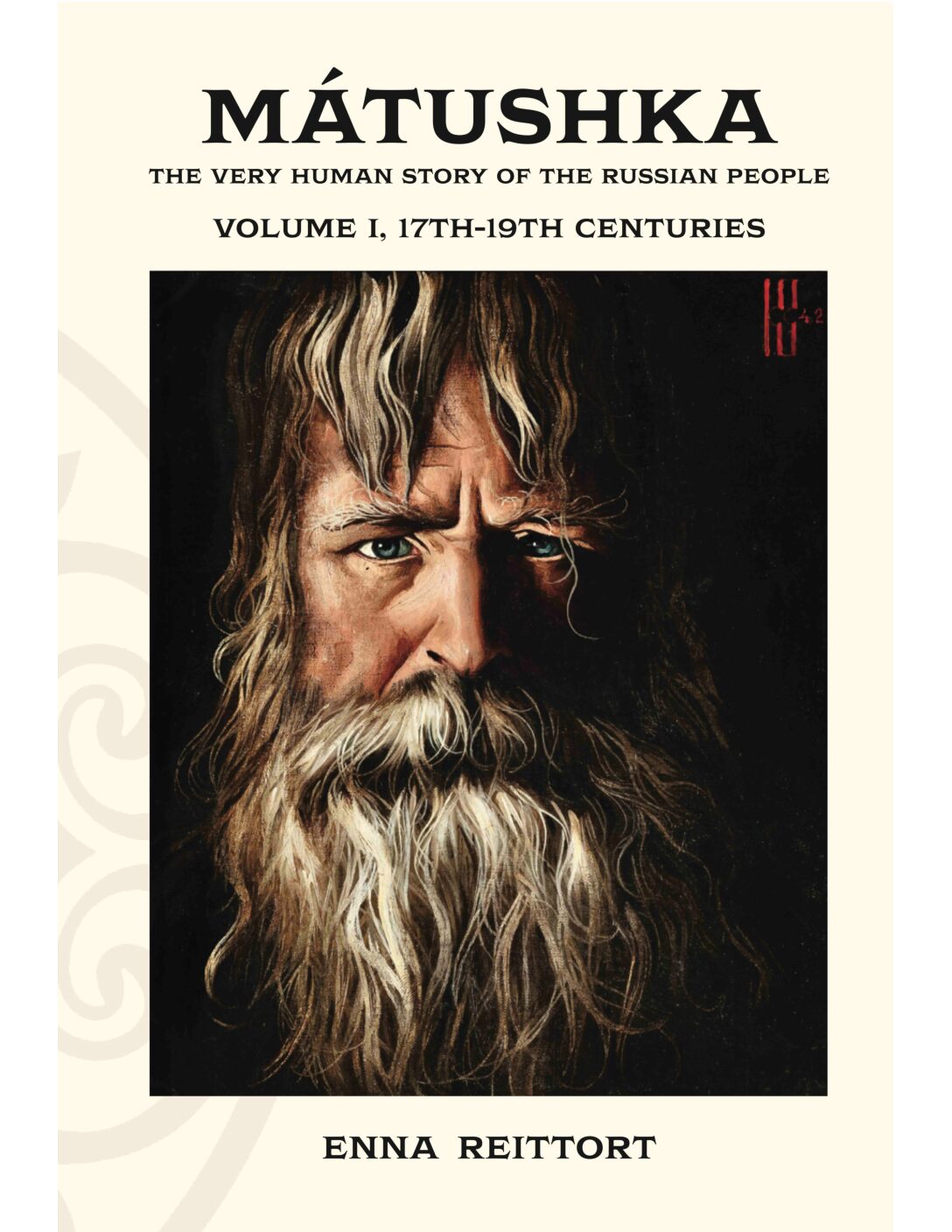
Do history books tell us anything much about ‘the people’? About their experience of the history that was made and written ‘from above’ and that we all studied in school? Hardly. We have internalized ‘the people’ as a silent passive mass, worth noticing only for the odd rebellion here and there. Is oblivion the best we can do for the ancestors of ninety-nine percent of us, and for our sense of where we stand today?
Here, Russia takes us into her own ‘history from below’. A people’s history that conventional ‘history from above’ cannot handle, it is better conveyed by a multifaceted, non-fictional story of the Russian people. In this volume, three centuries of socio-economic enslavement, of brutal spiritual and cultural suppression, were also three centuries of resistance, patient yet often violent, often heroic, against the drive to dehumanize Russianness. These were three centuries of diffuse or overt civil war between a westernized elite and the Russian people, who would soon be fully active agents of history ‘from above’ and ‘from below’ in the Russian revolution(s) and the Soviet century.
This book is not for firmly ‘Russophobic’ readers. It is for those who do not want to remain ignorant and brainwashed. For those who are open to discovering not only the human depth of a demonized people, but also patterns shared with the tribulations of all other peoples – those of the colonized ‘global south’ over some five centuries, and those of European peoples over some fifteen hundred years.
Praise for Mátushka:
The author has absorbed a considerable amount of literature by Soviet and Russian historians, not only those who dominate in the field, but also less well-known contemporary researchers whose work on under-appreciated archival material leads to different perspectives on many facts of Russian history.
Enna provides unusual depth, through her anthropological reading of historical facts, to a ‘history from below’, a history of the people.
A striking quality of this work is the author’s sensitive, involved perspective on the historical journey of the Russian people, an attitude far removed from mainstream western attitudes of Russophobia, as if Enna were somehow Russian at heart.
This book will appeal to the thoughtful western reader who wants to see beyond the myths and falsities, so extraordinarily prevalent nowadays, that demonize the reality of Russia and her role in the world. To readers who seek a clearer vision of historical processes in order to form their own understanding of Russia and her significance beyond her borders. –Oleg Shamanov, First-class Extraordinary and Plenipotentiary Envoy of the Russian Federation, retired.
Enna Reittort’s work has always keenly uncovered the inner soul of civilizations and ideologies. Mátushka is no different, providing the distilled essence of the Russian collective psyche, including the forces that shaped it and the nefarious social-engineering entities that plague so many cultures even today. If you want a work that is not a projection or propagandization of Russia, this is it, and her research goes a long way in understanding a people and their place in modernity. –Miguel Conner, author of The Occult Elvis, and host of Aeon Byte Gnostic Radio.
This important book is a welcome antidote to the current fad of Russophobia. With her detailed exploration of the last 300 years of Russian history, the author has gained deep insight into the very soul of Russia, a country that embodies the essence of a ‘split society’ – what she calls “two Russias within one”. As she points out, ‘the West is only beginning to discover that the powers-to-be do not belong to the same humanity as the people [because] observable polarities … are but the visible part of underlying ‘spiritual’ disassociation.’ We have much to learn from the Russian experience – not least how the female force, the Matushka, is a power that ultimately cannot be denied. No wonder Churchill said in the British Parliament in November 1919 about the Bolshevik Revolution, “…Russia was laid low. Russia had to be laid low. She was laid low to the dust”. The same anti-Russia sentiment sadly still prevails today probably for the same reasons.’ —Lucy Wyatt, author of Approaching Chaos: Could an Ancient Archetype Save C21st Civilisation? and the Chaos Encountered substack.